


FILMAR: The Challenge of Organizing Audiovisual Authors’ Rights in Bolivia
- Mar 18
- 5 min read

In Bolivia, the audiovisual sector is going through a period of transformation. Alongside a recent growth in film production, filmmakers themselves are working to build a structure capable of defending and managing their author’s rights. In this context, FILMAR was created — a collective management society founded by audiovisual creators and producers seeking to organize the collection and distribution of rights for directors, screenwriters, and producers.
By Ulises Román Rodríguez
Director and producer Viviana Saavedra, a member of the organization’s board, participated in November 2025 in the congress organized by AVACI and FESAAL in Croatia, where she shared the current situation of the audiovisual sector in Bolivia and the progress made toward establishing a collective management society.
A collective management society under construction
FILMAR obtained its operating license in 2022 from the National Intellectual Property Service after meeting the legal requirements to function as a collective management society. However, the challenge was only beginning.
The organization is still in a stage of institutional and technical consolidation. “Since its creation we have not yet been able to implement the collection platform, so we are currently in a process of renewing the license, developing the website, and receiving training to implement the collection system,” Viviana Saavedra told AV Creators News.
To move forward with this objective, members of FILMAR are currently participating in training programs in other countries in the region. The intention is to learn from the accumulated experience of collective management societies that have been operating for decades.

A particular legal structure
One of the distinctive features of the Bolivian model is that the legislation recognizes a single collective management society for directors, actors, and producers. This requires building an internal structure capable of representing the interests of all sectors of the audiovisual field.
Saavedra explains that the size of the market also influences this decision.
—In Bolivia there is a single collective management society for several sectors. How does this affect FILMAR’s organization?—The Bolivian audiovisual market is still small and the industry is emerging, so we must adapt to that reality. We are working on internal representations that ensure that decisions do not affect the interests of authors or producers. It is a challenge, although we know that other societies began in a similar way and later adjusted their regulations.
A process driven by audiovisual authors themselves
Unlike in other countries where collective management societies emerged with stronger institutional backing, in Bolivia the project was driven directly by filmmakers themselves.
FILMAR was founded only four years ago, and its initial development was sustained with resources contributed by members of the audiovisual community. According to Saavedra, this collective building process has also helped them understand the complexity involved in implementing a rights management system.
The organization continues to work on training its members and developing administrative tools that will allow it to begin collecting and distributing rights in the short term.
Learning from other experiences
The international congress organized by AVACI and FESAAL represented, according to Saavedra, a turning point for the Bolivian process.
The FILMAR representative says that the exchange with other societies helped them better understand the path that still lies ahead.
“We felt supported, like the younger siblings, but we also saw that we can benefit from the experience of other countries. We were especially interested in the models of Mexico, Brazil, Italy, and Spain,” she explains.
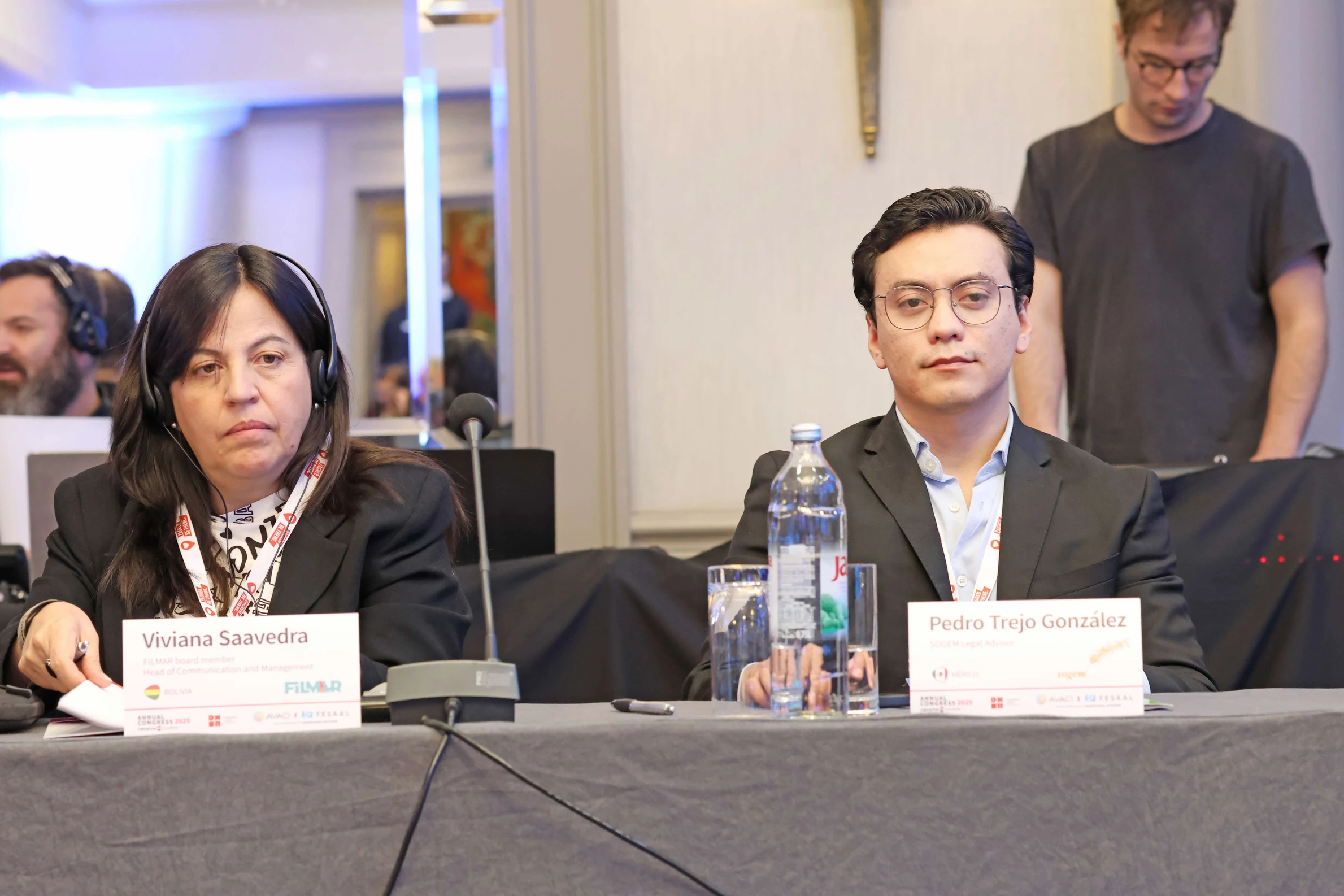


Viviana Saavedra at AVACI Congress 2025
At the same time, the Bolivian case also finds points of connection with other Latin American realities. “It was also very motivating to learn about the development of the collective management societies of Argentina, Colombia, and Uruguay. We realized that, compared with some neighboring countries such as Peru, Ecuador, or Paraguay, Bolivia has already made significant progress in this process.”
The current state of Bolivian audiovisual production
While institutional organization progresses slowly, Bolivian cinema is going through a period of growth in terms of production. According to Saavedra, in recent years several films have been developed thanks to specific public funds such as the Urban Interventions Program and the Bicentennial Fund, which have helped support new audiovisual projects. This increase in production has also generated the need to strengthen the sector’s institutional structures. “That growth forced us to organize ourselves,” she explains. “But there is still much to build, especially regarding the final regulation of the film law.”
Currently, the Bolivian government is promoting cultural forums aimed at discussing new public policies for the audiovisual sector, including the possibility of establishing an annual production support fund.


Authors’ rights: an unfinished agenda
In the field of collective management, the Bolivian audiovisual sector is still in an early stage. There are important precedents in other artistic fields, such as the musicians’ society SOBODAYCOM, which succeeded in consolidating a system for collecting royalties and providing social benefits to its members. For Saavedra, this precedent demonstrates the importance of having an entity that represents audiovisual creators. “For us it is essential that a collective management society exists. Today there are no clear mechanisms for collecting and distributing rights for audiovisual works, which makes the implementation of FILMAR urgent.” The board’s goal is for the society to begin full operations during the current year.
International networks and regional cooperation
Another important step in FILMAR’s development has been its integration into international networks of audiovisual authors.
—What does it mean for Bolivia to be part of networks such as FESAAL and AVACI?—Being part of these networks makes us stronger. It allows us to represent the rights of our authors and learn from the experience of other countries. We also hope to share our own experiences of collaboration.
According to Saavedra, regional support will be key to consolidating collective management in Bolivia and strengthening the position of creators in a sector that is still in the process of institutionalization.
A cinema with history and new challenges
Bolivian cinema has a significant tradition within Latin America. From the pioneering films of filmmaker Jorge Sanjinés and the Ukamau group in the 1960s to the emergence of new generations of filmmakers in the 21st century, the country has developed a cinematography deeply connected to social struggles and Andean cultural identity.
Today, while production is slowly growing, the main challenge lies in building institutions that guarantee the sustainability of the sector and the protection of its authors’ rights. In that path, FILMAR represents one of the most recent efforts to provide Bolivian audiovisual production with a management structure capable of supporting the creative development of its filmmakers.





Ukamau and Yawar Mallku, films by Jorge Sanjinés (photo: Grupo Ukamau)
Sources consulted
SENAPI – National Intellectual Property Service of Bolivia https://www.senapi.gob.bo
History of Bolivian Cinema – Cinemateca Boliviana https://www.cinematecaboliviana.net
Overview of Bolivian Cinema – Latin American Film Observatory https://www.observatoriocine.com


Comments